




Replacement Number Plates for the 25, 45, 75 and Classic Rovers
If you drive a Land Rover or Range Rover, you want our Land Rover number plate page instead. We make replacement Rover number plates in one size, 520mm x 111mm, from £25 to £64 a pair. One warning before anything else: the Rover 75 is the car to measure first, because its rear plate may not match that size.
MG Rover Group went into administration on 8 April 2005, and Rover-badged car production ended that April. So every Rover on the road is an existing car, and every plate we make for one is a replacement.
Rover 25, 45, 600, 800 and SD1 number plates, model by model
| Model (years sold in UK) | Best finish from our seven | Why it suits this car | Who it is wrong for |
|---|---|---|---|
| Rover 25 (1999 to 2005) | Standard or 3D Gel | A hatchback over 20 years old. A printed plate keeps it original, and 3D Gel adds a small lift. | Anyone wanting a deep show look who has not checked the recess. |
| Rover Streetwise (2003 to 2005) | 3D Gel | A 25 with chunkier bumpers and a raised ride height, so start with a shallow raised finish. | Anyone ordering 5D Gel before measuring the bumper depth. |
| Rover 45 (1999 to 2005, hatchback and saloon) | 3D Gel, or 4D 5mm on dark paint | Dark paint shows raised characters more clearly, so 4D 5mm earns its cost. | White or silver cars, where flatter finishes read cleaner. |
| Rover 75 (1999 to 2005, saloon and Tourer) | Standard or 3D Gel, once measured | Check the rear plate first. Start shallow and move up only if the depth allows. | Anyone who has not compared the rear recess with 520mm x 111mm. |
| CityRover (2003 to 2005), Metro (1990 to 1994) and Rover 100 (1994 to 1997) | Standard | Small hatchbacks. A flat plate keeps the original look at the lowest price. | Anyone fitting a deep finish without checking the bumper. |
| Rover 200 (1984 to 1999), 400 (1990 to 1999) and 600 (1993 to 1999) | Standard or 3D Gel | Cars from the 1980s and 1990s, with a period look worth keeping. | Anyone hoping for black and silver. All were built after 1 January 1980. |
| Rover 800 (1986 to 1999) | Standard, or 4D 5mm on dark paint | Saloon, fastback and coupe (from 1992). A plain plate suits a big, older saloon, and dark paint gives 4D 5mm something to work with. | Anyone planning black and silver. Every 800 was built after the cut-off date. |
| Rover SD1 built 1980 to 1986 | Standard or 3D Gel | A fastback hatchback built after the cut-off, so white front and yellow rear plates are required. A flat or lightly raised plate suits it. | Anyone assuming an SD1 can run black and silver. Only cars built before 1 January 1980 can. |
| Rover P4 (1949 to 1964), P5 (1958 to 1973), P6 (1963 to 1977) and SD1 built 1976 to 1979 | Standard | Printed characters suit cars that came long before raised plates. | Anyone wanting glossy raised characters on a car this old. |
Rover number plate prices: what the £39 gap buys, and who should skip it
Pairs run from £25 for Standard to £64 for 5D Gel, a gap of £39. In between, 3D Gel is £38 a pair, £13 over Standard, and 4D 5mm is £50, £25 over Standard. Singles run from £15 to £33.
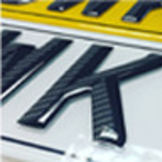
On an early-2000s Rover, here is what each step buys. Standard plates give the traditional printed look. 3D Gel adds raised black gel resin, a subtle change from standard. 4D 5mm is where the shadow becomes obvious, and it reads best on darker paint.
Do not pay for 5D Gel just because it tops the price list. Until you have measured the recess, the deepest finish is the riskiest one. On a white or silver car a flatter plate often looks cleaner. And if the Rover is a daily with no plans to show it, Standard does the job for £25 a pair.
Rover P4, P5, P6 and SD1 number plates: the 1 January 1980 rule
Black and silver plates may only be displayed on vehicles built before 1 January 1980. The word that matters is built, not registered. Our article on black and silver number plates sets out the other conditions that apply as well.
- P4 (1949 to 1964), P5 (1958 to 1973) and P6 (1963 to 1977): all built before the date.
- SD1 built 1976 to 1979: can qualify. SD1 built 1980 to 1986: cannot. Check the build date of your own car, because the registration year is not the same thing.
- 800, 600, 400, 200 from 1984, Metro, 100, 25, 45 and 75: all built after the date. They must show white front and yellow rear reflective plates.
Raised finishes look modern on a restoration, which is why the table points these cars to Standard. For a P6 or an early SD1, our guide to choosing a finish for a classic car goes further.
Two Rover number plate scenarios: a cracked rear plate and a restored SD1
Scenario: a cracked rear plate on a Rover 45 used every day
The rear plate has split at a screw hole and the front is tired. Both measure close to 520mm x 111mm. The choices are a single Standard plate at £15, a Standard pair at £25, or a 3D Gel pair at £38. The pair costs £10 more than the single and gives a matching front. The 3D Gel pair adds £13 to the Standard pair and clears the £30 line for free Tracked24 delivery. This is an illustration, not a customer story.
Scenario: Rover SD1 number plates for a 1979 car driven to club days
You have confirmed the build date of your 1979 SD1, so black and silver may be possible on the road, subject to the other conditions in our article. For a stand, show mode lets you set your own spacing and add bottom text of up to 60 characters, such as the model name. Show plates are display only, so the sensible setup is two sets: road plates for driving, show plates for the stand.
Road legal or show plates on your Rover: what a wrong plate costs you
A plate made for a public road must follow BS AU 145e, which has applied to newly made plates since 1 September 2021. It means black characters on reflective white at the front and on yellow at the rear. Each character is 79mm high and 50mm wide (except 1 and I), with a 14mm stroke, 11mm gaps, a 33mm gap after the age identifier and 11mm margins. The plate must also show the supplier name and postcode.
Here are the sums for a 2001 to 2005 style reg such as AB52 CDE. Seven characters at 50mm is 350mm. Five gaps of 11mm add 55mm, and one 33mm gap brings it to 438mm. Margins of 11mm each side add 22mm, giving 460mm. That leaves 60mm spare on a 520mm plate, and more if the reg has a 1 or an I.
Show plates are display only and never road legal. A plate that breaks the rules can fail the MOT, and you could be fined up to £1,000, according to gov.uk guidance on displaying number plates. Our page on which plates are road legal and which are show plates only explains the split. For the car you drive, order road legal number plates. In road legal mode, spacing and font are set for you.
Green flash number plates and Rover: none qualify
A green flash is only for zero-emission, pure battery electric cars. No Rover-badged production car was electric, so green flash does not apply to any Rover. Hybrids and mild hybrids do not qualify either.
Fitting a Rover number plate on a car that is 20 years or more old
Screws are the more reliable fix on any car, and an older one is no exception. Old screws can seize, so ease them out gently. Sticky pads work best on smooth, flat panels in normal weather, so they are a poor choice anywhere the surface is curved, rough or damp. A clean, dry, flat surface behind the old plate helps either method.
You can add a fitting kit when you order. We do not offer a fitting service, but our fitting guide walks you through screws, pads and plate holders. A raised 5D Gel plate needs more room than a flat Standard one, so measure the recess and plate surround before you pick it.
Looking after Rover number plates, and the O and 0 mistake
Raised finishes need gentler cleaning than flat plates. Use a soft cloth and plenty of water, and leave the stiff brush in the shed. Rinse first, because dragging grit across a gloss finish can scratch it.
The mistake we catch most often before dispatch is O for 0, and I for 1. Check each character against your V5C before you pay. The reg field takes up to 10 characters, with letters, numbers and spaces only.
Delivery and returns for Rover number plates
Tracked24 delivery is free on orders over £30. Order before 2pm and most plates are dispatched the same day. We send to the UK and Ireland, and you can pay by card or PayPal. Our plates are not suitable for vehicles registered outside the UK. Full terms are on our delivery and returns page.
Our pick of Rover number plates for each type of owner
Verdict: if you own a 25, 45 or 600 and want a tidy daily car, buy a 3D Gel pair for £38, which also clears the free delivery line. If your car is dark and you want it noticed, 4D 5mm at £50 is the step worth paying for. If you own a 75, measure first and choose the finish second. If you own a P4, P5, P6 or an early SD1, choose a Standard plate for the road and keep any show plate for the stand.
Why buy from Legal & Show Plates
We're a Bradford-based online plate maker shipping UK-wide, rated 5.0 on Google from over 300 reviews and 4.6 on Trustpilot. Order before 2pm for same-day dispatch, with a tracked 24-hour Royal Mail option available.
Questions Rover owners ask before they buy number plates
Q: What size is the Rover 75 rear number plate, and is it shaped?
Many 75s are described as having a rear plate larger than our 520mm x 111mm and shaped, not a plain rectangle. Do not rely on a quoted figure. Lay a tape across your old plate and the recess behind it, check for a curve, and compare both with 520mm x 111mm. If either is bigger or curved, do not order yet.
Q: What is the cut-off date for black and silver plates on a Rover?
It is 1 January 1980, and it is the date the car was built, not the date it was registered. A Rover built in 1979 can qualify even if its first registration came later. A Rover built in 1980 or after, including late SD1s, must show white front and yellow rear plates.
Q: Are 4D or gel number plates legal on a Rover?
Yes, on the road, when they are made to BS AU 145e with the legal font and spacing, white at the front and yellow at the rear. Raised 4D and gel characters are allowed when they follow those rules. The same finishes in show mode are display only.
Q: Do I need ID to order number plates for my Rover?
Yes, for road legal plates. We check ID and entitlement documents before we make one, whatever the car, so have them ready when you order. Check the reg against your V5C before you pay, so the plate matches your paperwork.
Q: Can I order just one number plate for my Rover?
Yes. Set the other quantity to 0 in the builder. Singles cost £15 for Standard, £20 for 3D Gel, £26 for 4D 5mm and £33 for 5D Gel. Only the £33 single clears the £30 free delivery line, so a pair often works out better.
Q: Can I put a show plate on my Rover for a car show?
Keep show plates for display, on a stand or on a car that stays off public roads. They are never road legal, whatever the finish or badge. Fitting one to a car you drive risks an MOT failure and a fine of up to £1,000, so keep a road legal pair on the car.
Q: Where can I buy a replacement number plate for a Rover 75?
Order online from us. Type your reg into the builder, choose road legal or show, pick a finish and set the front and rear quantity. Measure the rear recess against 520mm x 111mm first, because that is the only size we make.