




Road Legal Number Plates
A road legal number plate is not a style. It is a checklist set out in law, and it makes no difference whether the plate is flat printed, 3D gel, 4D or 5D. The Road Vehicles (Display of Registration Marks) Regulations 2001, along with the British Standard BS AU 145e that has applied to every plate fitted since 1 September 2021, sets exact requirements for font, character size, spacing, colour, reflectivity and the markings that must be printed on the plate. Meet every requirement and a plate is road legal, whatever finish it has. Miss one and it is not, no matter how good it looks.
This page sets out the checklist in full, with real measurements rather than a vague "correct spacing" claim, explains what actually happens if a plate falls short, and answers the questions we get asked most by people trying to work out whether a specific plate they are considering will actually be legal to drive.
The full legal checklist
Font. Every character must use the Charles Wright typeface, the standard font mandated since September 2001. No italic, outlined, shaded, script or decorative fonts are permitted on a road plate, regardless of finish.
Character size and spacing. For a standard car or van registered from 1 January 1973 onwards, the figures are fixed by law and do not vary between suppliers.
|
Measurement |
Requirement |
|
Character height |
79mm |
|
Character width |
50mm (narrower for the number 1 and letter I) |
|
Stroke width |
14mm |
|
Space between characters in the same group |
11mm |
|
Space between the two character groups |
33mm |
|
Margin at top, bottom and sides of the plate |
11mm |
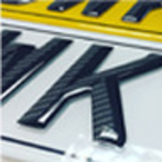
Colour. Characters must be a single, solid shade of black on every visible face, including raised 3D, 4D and 5D characters. Two-tone or shaded effects, where a raised letter appears a different shade on its side compared to its top, are not permitted, since they were found to interfere with automatic number plate recognition.
Background. The front plate must be white and the rear plate yellow, both made from genuinely retroreflective material rather than plain coloured plastic or paint. Retroreflective means the material bounces light back toward its source, which is what makes a plate readable by headlights and ANPR cameras at night, not simply that it looks pale in daylight.
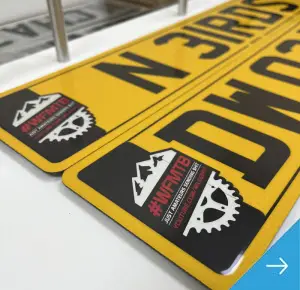
Permitted extras. Only specific badges and identifiers are allowed: the UK identifier with the union flag, national flags of England, Scotland, Wales or Northern Ireland with the relevant national letters, and the green flash for qualifying zero-emission vehicles. A single plain border is permitted provided it does not overlap the characters or the printed markings. Novelty badges, club crests, sponsor logos and decorative borders are not permitted on a road legal plate.
Markings. Every plate must carry the supplier's name and postcode, plus the relevant British Standard number, printed on the plate itself, typically in the bottom corner. Plates fitted since 1 September 2021 show BS AU 145e. This has to be printed as part of manufacture, not added as a sticker afterwards, and a plate without it is not road legal regardless of how correct everything else looks.
Why raised 3D, 4D and 5D characters are legal
This is one of the most persistently misunderstood parts of UK plate law, so it is worth addressing directly. Around the introduction of BS AU 145e in 2021, a rumour spread that 3D and 4D plates were being banned outright. That rumour was false, and a petition against a ban that was never actually planned circulated as a result. What the DVLA has confirmed, and what the standard itself sets out, is that raised gel and acrylic characters are permitted, provided they remain a single solid shade of black on every face. The thing that genuinely became illegal at that point was two-tone shading on raised characters, where the side of a letter is printed a lighter grey than the top to fake a 3D look without actually being raised. Genuine raised characters in solid black were never affected.
What happens if a plate does not meet the standard
Three consequences, roughly in the order most drivers actually encounter them. A roadside stop by police can result in a fine of up to £1,000 for a non-compliant plate. An MOT tester will fail the vehicle outright on plate grounds if the font, spacing, colour or markings are wrong, or if the plate is obscured, damaged or insecurely fixed, no discretion involved. And for anyone displaying a private or cherished registration incorrectly, the DVLA can, in the most serious or repeated cases, withdraw the registration from the keeper. None of that is scare tactics designed to upsell a more expensive option, it is simply why anything in our builder that would take a plate outside the standard gets flagged clearly before payment, not discovered afterwards.
Road legal plates in every finish we make
Standard printed, 3D gel, 4D and 5D gel can each be built fully road legal. What changes between them is purely the finish and the price, not whether the plate follows the rules, since the legal requirements sit on top of character colour, font and spacing regardless of how the character is constructed underneath. What we will not do is print the British Standard mark on a plate that has not actually earned it. If a customer specifically wants a font, colour or spacing that falls outside the standard, we will still make that plate, but it goes out clearly labelled and built as an off road, show use plate, without the markings that would misrepresent it as road legal.
Documents we ask for on road legal orders
Before manufacturing a road legal plate we ask for proof of identity, such as a photocard driving licence or a recent utility bill, and proof of entitlement to the registration, typically the V5C logbook or a new keeper supplement. This is standard practice across the industry and exists specifically to make it harder for stolen or cloned plates to be produced. It takes a few minutes at checkout and does not apply to show plates ordered for off road use, since those are not tied to a specific vehicle's legal display.
Every question people actually ask about road legal number plates
1. What actually makes a number plate road legal in the UK?
Meeting every part of the checklist above at once: Charles Wright font, correct character size and spacing, solid single-tone black characters, correctly reflective white front and yellow rear backgrounds, only the specific extras that are permitted, and the supplier details plus British Standard mark printed on the plate.
2. Are 3D and 4D number plates actually legal?
Yes. The DVLA has confirmed that raised gel and laser cut characters are permitted under BS AU 145e, provided they are a single solid shade of black on every visible face. The 2021 rumour that 3D and 4D plates were being banned was false.
3. What is the difference between BS AU 145d and BS AU 145e?
BS AU 145e replaced BS AU 145d on 1 September 2021 and applies to every plate fitted from that date onward. It tightened testing for weathering, UV resistance and reflectivity, introduced the optional green flash for zero-emission vehicles, and updated the required format of the supplier marking. Plates correctly fitted under BS AU 145d before September 2021 remain legal if they are still in good condition, but any new plate ordered today has to meet BS AU 145e.
4. Can I rearrange the spacing on my plate to make it spell something?
No. The spacing figures above are fixed measurements, not guidelines, and altering them to close up or widen a gap in order to change how the registration reads is illegal, whatever the intention behind it.
5. Is a border around the plate allowed?
A single plain border is fine provided it does not sit over any character or over the printed supplier markings. Patterned, coloured or reflective borders take the plate outside the standard.
6. Are tinted or smoked plate covers legal?
No. Anything that reduces legibility or alters the true colour of the background, including tinted covers, smoked overlays or coloured films, is not permitted on the road.
7. What documents do I actually need to buy a road legal plate?
Proof of identity, for example a photocard driving licence or a recent utility bill, and proof of entitlement to the registration, typically your V5C logbook or a new keeper supplement (V5C/2). This does not apply to show plates for off road use.
8. Do I need to tell my insurer if I fit road legal 3D or 4D plates?
Generally no, since a compliant plate is legally just a number plate rather than a vehicle modification, but policy wording varies between insurers, so a quick check costs nothing if you want certainty.
9. Will an incorrectly spaced or coloured plate fail an MOT even if it is otherwise in good condition?
Yes. MOT testers check plates specifically against the legal font, spacing, colour and condition requirements, and a plate that fails any one of those points fails the test outright regardless of how new or undamaged it otherwise is.
10. Can ANPR and speed cameras read road legal 3D and 4D plates properly?
Yes, provided the plate is built to the standard: solid black characters, correct font, correct spacing and correctly reflective background. Cameras read contrast and shape, not thickness, so a properly made raised character reads identically to a flat one.
11. What is the green flash and can I have it on any road legal plate style?
The green flash is a permitted marking for vehicles with zero tailpipe emissions, meaning pure battery electric and hydrogen fuel cell vehicles. It can be added to any of our road legal styles, standard, 3D gel, 4D or 5D, at no extra cost. Hybrids and plug-in hybrids do not qualify, since the rule is based on genuinely zero tailpipe emissions rather than low emissions.
12. Can I use a road legal plate design on private land or at a show, then drive home on public roads afterward?
Yes, if the plate is genuinely road legal to begin with, there is no restriction on driving it on public roads to and from an event. The distinction only matters the other way round: a show plate built outside the standard must never be driven on a public road, even briefly.