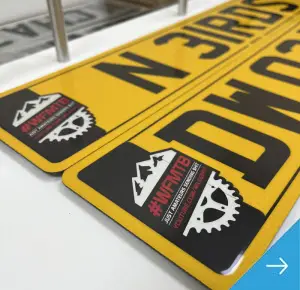





4D Gel Plates
4D Number Plates
4D number plates are the raised, laser cut acrylic style that has become the default choice for anyone upgrading from a flat plate. If you have ever looked at a car in traffic and noticed the registration throwing a hard shadow line under each letter, that is a 4D plate doing exactly what it is built to do. This page explains what 4D actually means, which of our three 4D options suits your car, and, more importantly than either of those, the honest answer to whether a 4D plate is road legal, because the true answer depends on how it is built, not on the name “4D” by itself.
Every road legal 4D plate that leaves our workshop is checked against the current British Standard before it is boxed.
What 4D Number Plates Actually Are
A 4D number plate is not a printed plate with a clever finish. Each character starts life as a flat sheet of solid black acrylic, which is then laser cut into the exact shape of that letter or number and bonded onto the base plate. Where a Standard plate has a flat, printed character and a 3D Gel plate has a printed character with a domed resin coating on top, a 4D character is a genuine solid block: square edged, with real physical height, sitting proud of the plate surface.
That physical height is what produces the look. In direct sunlight, or under a streetlight at night, a 4D character throws a visible shadow along its lower edge, the way any raised object does. It is this shadow line, not marketing, that gives the finish its depth, and it is the reason 4D has become the standard upgrade on modified and performance cars across the UK over the last several years.
It is worth being precise about the name itself. “4D” is a trade term, not a legal category and not a unit of measurement. The DVLA and the British Standard do not use the phrase “4D” anywhere. What they regulate is far simpler: character height, width, stroke width, spacing, colour and reflectivity, whatever method was used to build the character. That distinction matters for the next section, so keep it in mind.
4D 3mm vs 4D 5mm vs 4D Gel Number Plates: How To Choose
We sell three different 4D number plates, and they get confused with each other more often than any other part of our range, largely because the names are close and the visual difference in a small product photo is not always obvious. Here is what actually separates them.
4D (3mm) uses acrylic characters cut to 3mm thickness. This is the entry point into the 4D range: enough raised depth to be genuinely noticeable against a flat plate, without being the most dramatic option we sell. It is the plate most people mean when they first search “4D number plates” and it is priced accordingly.
4D (5mm) uses the same laser cutting process at 5mm thickness, roughly two thirds thicker again. The extra material depth means a longer shadow line and a more pronounced block letter, particularly noticeable head on and in photographs taken in strong light. It costs more because there is more material and more cutting precision involved in keeping a taller character bonded flat and square.
4D Gel (3mm) takes the 3mm laser cut acrylic character used in the standard 4D plate and adds a clear gel resin topcoat over it. This is where people most often mix up our range, so it is worth stating plainly: 4D Gel is not the same product as 3D Gel. 3D Gel is a printed, flat character with a gel dome sitting directly on top of it, there is no laser cut acrylic underneath at all. 4D Gel starts with the same laser cut acrylic letter used in our plain 4D plates, then adds the gel coating on top. The result is more depth than 3D Gel and more gloss than plain 4D acrylic, which is why it costs more than either.
| Option | Thickness | Finish | Price (pair) | Best suited to |
|---|---|---|---|---|
| 4D (3mm) | 3mm laser cut acrylic | Matte to satin acrylic, no gel coating | £38 | A first step up from a flat plate, subtle and clean |
| 4D (5mm) | 5mm laser cut acrylic | Matte to satin acrylic, no gel coating | £50 | A deeper, more dramatic shadow line, favoured on modified and performance cars |
| 4D Gel (3mm) | 3mm laser cut acrylic plus gel topcoat | Glossy, slightly domed over the raised character | £54 | Buyers who want depth and shine together |
If you are choosing between the three purely on looks, 3mm is the subtle option, 5mm is the bold option, and 4D Gel sits between them in depth but ahead of both on gloss. Prices are confirmed at checkout, since they can be updated from time to time.
Are 4D Number Plates Legal in the UK
This is the question that matters most, and it deserves a straight answer rather than a blanket line.
The current mandatory standard for any UK number plate supplied or fitted since 1 September 2021 is BS AU 145e. It replaced the older BS AU 145d, so a website still marketing new plates against 145d is working from out of date information. Under BS AU 145e, raised solid black characters, of the kind used in a 4D plate, are explicitly permitted. The standard is concerned with the finished dimensions and colour of the character, not the manufacturing method used to produce it. So a 4D plate can absolutely be road legal, and most of the 4D plates we make are exactly that.
But “can be” is doing real work in that sentence, because road legality depends on every element of the plate meeting the standard together, not on the raised character alone. Here is what BS AU 145e actually requires, taken from the gov.uk INF104 guidance and the gov.uk rules on displaying number plates:
- Character height: 79mm
- Character width: 50mm, except the number 1 and the letter I
- Stroke width: 14mm
- Space between characters: 11mm
- Space between the age identifier and the random letters (for example, the gap between “24” and “ABC”): 33mm
- Margins, top, bottom and side: 11mm
- Front plate: black characters on a white, retroreflective background
- Rear plate: black characters on a yellow, retroreflective background
- Characters must be a single, solid shade of black. Two tone or gradient character faces are not permitted. A raised or 3D character is fine, because the finish is dimensional, not a colour effect on the face
- The manufacturer’s name and postcode must appear on the plate, roughly 3 to 10mm tall, positioned about 7mm below the characters, along with the BS AU 145e mark
Where this catches people out on 4D plates specifically is spacing and font, not depth. Our road legal 4D range uses the Charles Wright font, standard character size and standard spacing, exactly as set out above, and it carries the supplier and standard markings the law requires. That is what makes it road legal, not the fact that the characters happen to be raised.
The same builder that makes our road legal plates also offers genuine show options: coloured character edges, tints, show fonts and show spacing. If you choose any of those, the resulting plate is for off road and display use only, and our builder tells you this clearly before you pay, rather than leaving it as small print. This is one of the clearer ways our site differs from some competitors, who market their entire 4D range as “100% road legal” while quietly selling neon, crystal or coloured character options elsewhere on the same site that cannot meet the standard above. If a supplier will not tell you plainly which of their own products are road legal and which are not, that is worth noticing before you order.
What happens if a plate is not compliant. A non-compliant plate can fail an MOT on the spot, the police can issue a fine of up to £1,000, and the plate can be confiscated. These consequences apply whether the non-compliance comes from wrong spacing, a show font, a tint, or a missing supplier mark, regardless of how the character was manufactured. For the full plain-English breakdown, read our number plate compliance guide.
4D Number Plate Pricing
Our current 4D range pricing, per pair:
- 4D (3mm): £38
- 4D (5mm): £50
- 4D Gel (3mm): £54
For context, the rest of our range runs from Standard at £25 up to 5D Gel (5mm) at £64 and Black Diamond at £60 introductory, usually £75. Prices are confirmed at checkout since they are occasionally updated.
Our plate styles, in our own words
- Standard Number Plates: Manufactured using premium reflective materials to meet UK road legal requirements. A durable, high-quality finish makes them the perfect choice for everyday driving and replacement plates.
- 3D Gel Number Plates: Featuring raised gel characters for a sleek, glossy finish. Road legal and built to last, offering a stylish appearance while maintaining excellent visibility.
- 4D Number Plates (3mm): Precision-cut 3mm acrylic characters for a clean, modern look. Manufactured from premium materials, providing a bold finish that’s perfect for drivers wanting a subtle 4D upgrade.
- 4D Number Plates (5mm): Extra-thick acrylic characters create a deeper, more striking appearance while maintaining a high-quality, professional finish.
- 4D Gel Number Plates (3mm): Combining the bold appearance of 4D acrylic with a glossy gel coating for a truly premium finish. The raised 3mm characters add depth, shine and a distinctive modern look.
- 5D Gel Number Plates (5mm): Extra-thick 5mm acrylic characters finished with a crystal-clear domed gel coating. Designed for maximum visual impact, delivering the most premium look in the range.
- Black Diamond Number Plates: Our most exclusive design, featuring precision diamond-cut characters that create a stunning crystal-like sparkle as they catch the light. Combining a deep gloss black finish with premium craftsmanship for an elegant, luxury appearance unlike any other plate style in the range.
Who 4D Number Plates Suit Best
4D plates suit drivers who want a visible, tactile upgrade from a flat plate without moving to a domed gel finish. In practice, we see three groups buying 4D most often.
Owners of modified or performance cars. The raised block letter and its shadow line reads as intentional and finished on a car that already has other visual upgrades, lowered suspension, alloy wheels, a wrap or a respray. It photographs sharply and looks deliberate rather than default.
Owners replacing a worn or damaged plate who want more than a like for like swap. Moving from Standard to 4D (3mm) is a modest price step for a noticeably different look, and it is the single most common upgrade path we see.
Buyers who want depth without the most premium finish in the range. 4D sits below 5D Gel and Black Diamond on price while still delivering a raised character, the practical middle ground for someone who wants their plate to look considered without spending at the top of the range.
How 4D Number Plates Look on Different Cars
Dark cars, black, dark grey, navy. This is where 4D reads most dramatically. The contrast between the solid black character, its shadow, and a dark body colour is high, and the raised edge catches whatever light is available even on an overcast day. Of our whole range, 4D and 4D Gel photograph best against a dark body colour.
Light cars, white, silver, light grey. The raised character still stands out clearly, but the contrast is naturally softer against a light body. 4D still looks sharp here, it simply reads as clean rather than dramatic.
Executive and premium saloons. 4D (3mm) tends to suit this category better than 5mm. The subtler depth reads as a quality upgrade rather than a style statement. If the brief is “still looks factory, just sharper,” 3mm is usually the better call.
Performance and modified cars. This is 4D’s natural home, and 4D (5mm) or 4D Gel in particular. The deeper shadow line and, on the gel option, the added gloss both suit a car that is already visually styled. It is the most common combination we see ordered together.
Electric vehicles. 4D works well on EVs, and many owners pair it with the green flash option where the vehicle genuinely qualifies as zero emission. The green flash is only for vehicles meeting that criteria, not plug in hybrids, so do not add it to a PHEV expecting it to be compliant.
How 4D Compares With 3D Gel and Standard Plates
- Against Standard. Standard is flat, printed and the cheapest option at £25 a pair. It has no raised edge to catch on a jet wash, making it the most durable choice under repeated hard washing, but none of the visual depth 4D offers. If durability under harsh, frequent washing is your only concern, Standard is the honest recommendation, not the upsell.
- Against 3D Gel. 3D Gel uses a printed character with a gel resin dome on top, no laser cut acrylic underneath. It sits closer to the plate surface and reads as glossy rather than raised. Want visible height and a hard shadow line, 4D is the closer match. Want gloss without the more assertive block letter, 3D Gel is the gentler, cheaper option at £38.
- Against 5D Gel and Black Diamond. Both sit above 4D on price, and 5D Gel uses 5mm acrylic with a gel topcoat rather than the plain acrylic finish of our 4D 5mm option. If you want 4D’s raised look but are tempted by extra gloss, 4D Gel (3mm) is worth comparing directly against 5D Gel (5mm) before you commit, since the difference is mainly depth and price, not legality or quality.
Common Mistakes When Ordering 4D Number Plates
- Ordering 5mm without measuring the recess. Some vehicles, particularly certain Audi and Mercedes models with sculpted rear bumpers, have a shallower recess than the raised depth of a 5mm character allows for. Measure before you order, not after.
- Confusing 4D Gel with 3D Gel. These are different products, built by different processes, as covered above. If you are ordering by name from memory, double check which one you actually mean.
- Assuming every option in the builder is road legal. The same builder sells both our compliant range and genuine show options. Read the legality note the builder gives you for the specific configuration you have chosen, rather than assuming the whole product line carries one blanket status.
- Fitting with old or reused adhesive pads on a dirty bumper. A raised, laser cut character adds weight compared with a flat printed plate. Reusing old pads, or fitting to a bumper that has not been cleaned first, is the most common reason a heavier plate comes loose, and it is avoidable with a proper fitting kit and a clean surface.
ANPR and MOT: The Reality for 4D Plates
ANPR cameras work by reading contrast between the dark characters and the light retroreflective background, along with correct character spacing and font, not the physical depth of a character. A 4D plate made correctly to BS AU 145e reads to an ANPR camera the same way a flat Standard plate does.
The same logic applies at an MOT test. A tester checks legibility, spacing, colour and the presence of the supplier markings, not whether the character is raised. Where 4D plates genuinely do fail MOT or ANPR checks, the cause is almost always a show font, incorrect spacing, a tint, or missing supplier markings, nothing to do with the acrylic being raised. Our full legal guide to 4D plates and our separate piece on how ANPR actually reads a 4D plate cover both in more depth.
Insurance and 4D Number Plates
A road legal 4D plate does not change your vehicle’s technical specification, unlike an engine remap or a suspension change. That said, insurers vary in what they classify as a notifiable modification. If you are in any doubt, a quick call to your insurer to check their specific position is worth it, rather than relying on a blanket assurance from us or anyone else that it will never need declaring.
4D Number Plate FAQs
1. Are 4D number plates legal in the UK?
Yes, when built to BS AU 145e: correct character height and spacing, Charles Wright font, retroreflective background, and the supplier name, postcode and standard mark present on the plate. The raised acrylic character itself is permitted under the standard. Show options such as coloured edges or show spacing are not road legal and are for off road use only.
2. What is the difference between 4D 3mm and 4D 5mm?
Both use the same laser cut acrylic process. 3mm gives a subtler raised look and is our lower priced 4D option at £38 a pair. 5mm uses thicker acrylic for a deeper shadow line and more pronounced block letter, priced at £50 a pair. There is no legal difference between the two, only depth and price.
3. What is the difference between 4D Gel and 3D Gel?
3D Gel is a printed character with a gel resin dome directly on top, with no laser cut acrylic underneath. 4D Gel starts with a laser cut acrylic character, the same as our plain 4D plates, and adds a gel topcoat over that raised acrylic. 4D Gel has more physical depth than 3D Gel as a result.
4. Will 4D number plates work with ANPR cameras?
Yes, provided they are made to BS AU 145e spacing and font. ANPR reads contrast between the characters and the background, and correct spacing, not the physical depth of the character.
5. Will a 4D plate affect my MOT?
Not if it meets BS AU 145e in full. A tester checks legibility, spacing, colour and supplier markings, none of which are affected by the character being raised, provided every other requirement is also met.
6. Do I need to declare a 4D plate to my insurer?
A road legal 4D plate does not change your vehicle’s technical specification, but insurers vary in what they treat as a notifiable change. Check with your insurer directly if you are unsure.
7. How do I clean a 4D number plate?
Water and a mild detergent, by hand or with a soft cloth. Avoid abrasive pads on the raised characters, and avoid pointing high pressure jet wash equipment directly at the character edges from close range.
8. How long does delivery take?
Orders placed before 2pm are dispatched the same working day, with Royal Mail delivery typically taking 1 to 3 working days. A tracked 24 hour option is available at checkout.
More questions are answered on our full FAQ page.