Our Compliance Promise
Number plates are a regulated product, not a customisation accessory, and the rules that govern them deserve a plain-English explanation rather than a line of small print at the bottom of a checkout page. This page sets out exactly what “road legal” means under UK law, what we check before any plate leaves our workshop, and where the honest line sits between a road legal plate and a show plate. If you read nothing else on this site before you order, read this.
We sell both road legal number plates and display-only show plates from the same plate builder, so the distinction matters to us as much as it matters to you. Getting it wrong isn’t a small mistake. A non-compliant plate on a public road can fail an MOT, attract a fine, and get the plate taken off the car. This page is where we explain how we avoid that, and how you can check it for yourself.
What “road legal” actually means
A road legal number plate in the UK has to meet a specific British Standard, use a specific font, be spaced to specific measurements, and carry the details of the business that made it. None of that is negotiable, and none of it is a matter of taste. A plate either meets the standard or it doesn’t, and the difference between “close enough” and compliant is often a few millimetres.
This matters because the rules aren’t really about appearance. They exist so that automatic number plate recognition (ANPR) cameras, police officers, and MOT testers can read a registration accurately and instantly, day or night, in any weather. A stylised font or cramped spacing that looks fine to a human eye can still fail a camera read, and that’s the practical reason the specification is as detailed as it is.
What is BS AU 145e?
BS AU 145e is the current British Standard for number plates supplied or fitted to vehicles used on UK roads. It has applied since 1 September 2021, replacing the older BS AU 145d standard. Any plate made and sold as road legal in the UK today should be manufactured to BS AU 145e, not the superseded 145d version.
The standard sets out the physical construction of a compliant plate: the font, the character dimensions, the spacing, the reflective properties of the material, and the markings a supplier has to print on it. It’s a manufacturing specification first and a legal requirement second, which is why we talk about it in terms of measurements rather than opinions.
The law behind the standard
BS AU 145e doesn’t exist in isolation. It sits underneath The Road Vehicles (Display of Registration Marks) Regulations 2001, the actual piece of UK law that governs how registration marks must be displayed on a vehicle. The regulations set the legal requirement to display a registration mark correctly, and BS AU 145e is the technical standard that defines what “correctly” means in physical terms, from the shade of black used on the characters to the size of the margin around them.
Gov.uk publishes a plain-English summary of the rules at gov.uk/displaying-number-plates and a more detailed breakdown of the specific requirements at gov.uk/displaying-number-plates/rules-number-plates. If you want the requirements from the source rather than from a supplier’s summary, including ours, those two pages are where to go.
The full BS AU 145e specification, explained
This is the specification we work to on every road legal plate. We’re publishing the actual numbers rather than a vague “meets British Standard” claim, because the numbers are what actually determines whether a plate is legal.
- Font: Charles Wright, the only typeface permitted on a UK road legal plate. No stylised, italic, joined-up, or coloured variants are compliant, regardless of how they’re marketed.
- Character height: 79mm for standard characters.
- Character width: 50mm, except for the number 1 and the letter I, which are narrower by design because of their shape.
- Stroke width: 14mm, meaning the thickness of the line that forms each character.
- Spacing between characters: 11mm.
- Gap between the age identifier and the rest of the registration: 33mm. This is the space between, for example, the “24” in a plate and the three letters that follow it.
- Margins: 11mm between the characters and the edge of the plate.
- Background and character colour: black characters on a white retroreflective background at the front of the vehicle, and black characters on a yellow retroreflective background at the rear.
- Character shading: solid, single-shade black only. No two-tone, gradient, faded, or 3D-shadow effect characters are compliant, whatever the raised finish looks like from the front.
- Supplier markings: the name and postcode of the business that supplied the plate, printed on the plate itself, roughly 3mm to 10mm tall and positioned about 7mm below the registration characters.
Every one of those figures has to be met together, not selectively. A plate with the correct font but the wrong spacing is not compliant. A plate with correct spacing but no supplier markings is not compliant either. This is the level of detail we measure to on the workshop floor, not just the headline claim of “BS AU 145e compliant” that gets printed on a lot of product pages without the numbers behind it.
How we check who you are before making a road legal plate
Before we make and dispatch a road legal plate, we check the customer’s identity and their entitlement to the registration they’re ordering. In practice that means asking for one of the standard documents that prove a legitimate link to the registration: a V5C logbook, the V5C/2 new keeper supplement, a V750 or V778 registration certificate, or a valid eV948 from a dealer or fleet operator.
We don’t ask for this level of checking on show plates, because a show plate is never fitted to a car on the road in the first place, so the same entitlement risk doesn’t apply in the same way.
Show plates: what they are and where the line sits
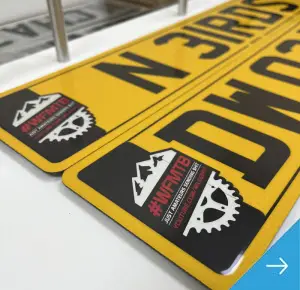
We make show plates as well as road legal ones, and we’re upfront that they’re a different product with a different purpose. Show plates use fonts, colours, spacing, or finishes that fall outside the BS AU 145e specification, built for off-road use, static display, motorsport paddock areas, and photography.
A show plate does not carry our supplier name and postcode, and it does not carry the BS AU 145e mark. That’s a deliberate decision, not an oversight. Printing supplier details or a compliance mark on a plate that isn’t actually compliant would be a false claim, and we won’t put our name on a plate as if it were road legal when it isn’t. If you see a plate with no supplier details on it, that absence is doing its job.
A show plate must never be fitted to a vehicle that is driven, parked, or even briefly present on a public road. That includes pulling onto a road to move a car between two private locations. If a plate is going anywhere near a public road, order the road legal version, which you’ll find on our dvla number plates page. Full detail on what a show plate is for, and isn’t for, is on our show plates page.
What we check before every plate leaves our workshop
Compliance isn’t just a specification on paper, it’s a set of checks we actually carry out on every road legal order before it’s packed.
- Character spacing is measured against the BS AU 145e gauge on every plate, not eyeballed against a template.
- Gel domes are inspected under angled light for even fill and air bubbles on any raised finish, and 4D letters are press tested at the corners to check the bond is solid.
- Supplier name, postcode, and the BS AU 145e mark are confirmed present on every road legal plate, and confirmed absent on every show plate.
- The registration is double checked against the order details, and for road legal orders, against the entitlement document supplied.
- Every plate is packed in rigid packaging. A bent plate is unusable and can fail the flatness requirement of the standard, so we don’t ship in loose bags or thin card.
These aren’t marketing claims, they’re the physical checks a plate has to pass before it’s allowed to go in a box. If a plate doesn’t pass one of them, it doesn’t get dispatched.