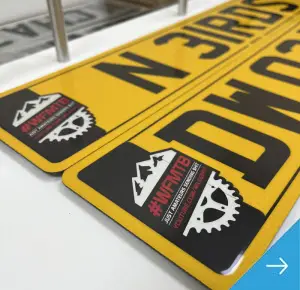





Gel Number Plates
Run a finger over an ordinary printed number plate and it is completely flat. Run it over a gel plate and each character stands slightly proud, rounded, catching light differently depending on where you are standing. That physical difference, a raised, glossy dome sitting on top of the letter instead of ink printed onto a flat sheet, is what a gel plate actually is, and it is why it has become the most requested upgrade in the UK plate market.
The confusion usually starts with the name. "Gel plate" gets used as a catch-all for three genuinely different products: 3D gel, 4D gel and 5D gel. They are not marketing tiers of the same thing. They are built differently, they look different from three feet away, and they suit different cars.
What a gel plate actually is, and how it is made
A standard number plate is a flat acrylic sheet with the registration printed directly onto it, then covered with a protective laminate. Nothing sits above the surface.
A gel plate starts the same way and goes a step further. A clear polyurethane resin, the "gel," is applied over each character and cured until it sets hard and glossy. That resin is what creates the dome. On a 3D gel plate, the resin sits directly over a printed character, so the raised part is relatively shallow, typically 1 to 2mm. On a 4D gel plate, a solid acrylic letter is laser cut first and bonded to the plate, and the resin is then applied over that raised letter, which is why 4D characters stand up further, usually 3mm or more, and throw a visible shadow in direct light. 5D gel takes the 4D construction and adds a second gel layer on top of the first, pushing the depth and gloss further again. It is the deepest finish we make.
None of this changes whether the plate is legal. Legality depends on colour, font, spacing and markings, not on whether the characters are flat or raised. The DVLA confirmed this directly after a 2020 to 2021 rumour claimed 3D and 4D plates were being banned under the new British Standard, BS AU 145e, which came into force on 1 September 2021. That rumour was false, and it even led to a petition against a ban that was never actually happening. What the new standard did introduce was a requirement that raised characters be a single, solid shade of black on every visible face. Two-tone or shaded 3D effects, where the side of a raised letter is printed a different shade to the top, were the thing that actually became illegal, not raised characters as a whole.
3D gel, 4D gel and 5D gel compared
|
|
3D Gel |
4D Gel |
5D Gel |
|
Build |
Gel resin domed directly over a printed character |
Laser cut acrylic letter, gel resin over the top |
4D build with a second gel layer added |
|
Typical height off the plate |
1 to 2mm |
3mm or more |
Greater than 4D |
|
Visual effect |
Smooth, subtle, glossy dome |
Bold, square edged, deep shadow in daylight |
Deepest gloss and shadow of the three |
|
Best suited to |
Family cars, leased cars, private plates |
Modified cars, performance cars, show cars |
Owners who have already seen 4D and want more |
|
Can it be road legal |
Yes, solid black, standard font and spacing |
Yes, solid black, standard font and spacing |
Yes, solid black, standard font and spacing |
|
Price per pair (road legal configuration) |
£38 |
£54 |
£64 |
Prices above are for the standard road legal build. Show fonts, coloured resin, tints and non-standard spacing are priced separately in the online builder and are not road legal.
Are gel number plates legal in the UK?
Yes. UK number plate law comes from the Road Vehicles (Display of Registration Marks) Regulations 2001, and every plate fitted since 1 September 2021 has to meet the British Standard BS AU 145e. That standard does not ban raised or domed characters. It specifically permits three-dimensional gel and acrylic characters, provided every character is a single, solid shade of black on all visible faces, the Charles Wright font is used at the correct size, the spacing between characters follows the legal measurements, and the plate carries the correct reflective background and supplier markings.
A gel plate becomes illegal when the resin is tinted or coloured rather than solid black, when the characters use a show font instead of Charles Wright, when the spacing has been altered to squeeze letters together or spell something, or when the plate lacks the printed supplier details and British Standard mark. We make gel plates in both configurations. Choose the road legal build and every one of those boxes is ticked. Choose a show font or coloured resin and the plate is built for off road use only, and the builder tells you that clearly before you pay.
Gel plate character rules, in full
For a standard car plate registered from 1 January 1973 onwards, the legal measurements are fixed and do not vary by supplier:
|
Measurement |
Requirement |
|
Character height |
79mm |
|
Character width |
50mm (narrower for the number 1 and letter I) |
|
Stroke width |
14mm |
|
Space between characters in the same group |
11mm |
|
Space between the two character groups (for example between AB12 and CDE) |
33mm |
|
Margin at the top, bottom and sides of the plate |
11mm |
A gel dome sitting on top of a character does not change any of these underlying measurements. The raised resin follows the same footprint as a flat printed character would. This is one of the most common misunderstandings customers bring to us, the assumption that a taller, glossier letter must somehow be a different size. It is the same legal dimensions with a different surface finish on top.
Will gel plates be read correctly by ANPR and speed cameras?
Yes, when built to the standard. Automatic Number Plate Recognition cameras read the contrast between black characters and a reflective background, along with the specific font shape, often at speed, at night, or in poor weather. That is exactly why BS AU 145e is strict about solid single-tone black characters and correct reflectivity. A gel plate made in solid black, standard font and correct spacing reads no differently to ANPR software than a flat printed plate.
Where readability problems have actually come from is cheaper suppliers, not gel as a category. Some low-cost 3D characters imported from overseas use a resin closer to a soft glue than a proper UV stable polyurethane, which can distort in UK weather and go patchy over a year or two. Others apply the resin over a clear or dyed vinyl backing rather than solid black, which can look fine to the eye in daylight but reduce infrared contrast enough to confuse ANPR software. That is a material and manufacturing issue, not a legal loophole, and it is why we use UV stable resin over solid black backing on every gel character we cut.
3D gel or 4D gel: which should you actually choose?
If you want an upgrade that most people will not consciously notice but everybody will say looks smarter, choose 3D gel. It reads as a well finished factory plate rather than a modification. This is where most of our lease car, family car and newly transferred private plate customers land, usually without trying anything else first.
If you want the plate to be noticed, choose 4D. The laser cut base gives real height and a defined shadow line that shows up clearly in photographs and in person, which is why it is the finish most commonly seen on modified and show cars.
If you have already seen 4D somewhere and want more, that is 5D. It is a smaller niche choice, but it exists precisely for people who found 4D good but not quite enough. None of the three is more or less legal than the others when built in the standard configuration. The difference is purely how bold you want the plate to look.
Who gel plates suit, and who should stick with a standard plate
Gel plates make sense if you have just picked up a new car, recently transferred a private registration, or you simply want the front of the car to match the effort you have put into the rest of it. Lease drivers like them for a specific practical reason: keep the original dealer plates in the glovebox, run the gel plates for the duration of the lease, then swap the originals back on before handover and take the gel plates with you to the next car.
A standard printed plate makes more sense if your car spends its life somewhere genuinely hostile to a raised finish, a working farm, a building site, anywhere gravel and debris are a daily reality, since a flat plate is cheaper to replace after the inevitable stone chip. It also makes more sense if the only thing you actually need is the cheapest legal way to replace a cracked or faded plate.
How to look after a gel number plate
Hand wash with warm water and ordinary car shampoo, using a soft cloth or sponge. If you use a pressure washer, keep the lance at least a metre back from the plate rather than blasting the characters directly, since sustained close range pressure can, over years, work at the edge bond between the resin and the base. Avoid solvent based cleaners, tar removers and anything abrasive on the gel surface specifically, plain soap and water is genuinely all it needs. Looked after this way, a properly bonded gel plate should still look sharp five years or more after a cheaper printed plate would have gone dull and chalky from UV exposure.
Delivery and how orders work
Most orders arrive within 1 to 3 working days through Royal Mail, and a tracked next day option is available at checkout if you would rather have a guaranteed delivery date. Because plates are made to your specific registration, we ask for proof of identity and proof of entitlement to that registration before manufacture on any road legal order, which helps reduce plate cloning across the industry, not just for us.
Every question people actually ask about gel number plates
1. Are gel number plates legal in the UK?
Yes, when the characters are a single solid shade of black, in the correct Charles Wright font, at the correct size and spacing, with the correct reflective background and supplier markings printed on the plate. Coloured, tinted, glittered or show-font gel plates are not road legal and are sold as off road use only.
2. What is the actual difference between 3D and 4D gel plates?
3D gel is resin domed directly over a printed character, typically 1 to 2mm proud of the plate. 4D is a laser cut acrylic letter with gel resin on top, typically 3mm or more proud, with a more defined shadow.
3. Will gel plates pass an MOT?
Yes, provided they are built to the legal specification. MOT testers check that plates are legible, correctly formatted, securely fixed and undamaged. A gel plate in solid black, correct font and spacing passes those checks the same as any flat printed plate.
4. Can ANPR cameras and speed cameras read gel plates properly?
Yes, when the plate uses solid black characters over a solid black backing with correct reflectivity. Historic complaints about raised plates confusing cameras have generally traced back to poor quality resin or dyed vinyl backing on cheap imported characters, not to gel plates as a category.
5. Do gel plate characters fall off or come loose?
Not when properly bonded during manufacture. Every plate is checked by hand for bonding before it is posted, and if a character were ever to lift, that would be a manufacturing fault covered under our returns process, not something you would need to fix yourself.
6. Can I put a coloured border or badge on a road legal gel plate?
A single plain border that does not overlap the characters or the printed markings is permitted. Permitted badges are limited to specific approved identifiers, such as the UK badge with the union flag. Novelty badges, club crests and decorative borders take a plate out of road legal territory and into show plate territory.
7. Is there a weight difference between gel and standard plates, and does it matter for fitting?
Gel plates are marginally heavier than a flat printed plate because of the added resin, though not dramatically so. It matters slightly for fitting: sticky pads need a clean, dry, room temperature surface to bond properly to the extra weight, which is why we recommend screws as a backup on cars with textured or curved plate recesses.
8. Can I get the green flash on a gel number plate?
Yes. If your vehicle is a pure battery electric or hydrogen fuel cell vehicle, the green flash can be added to a road legal gel plate at no extra cost. Hybrids and plug-in hybrids do not qualify, even those with genuinely low emissions, since the rule is based on zero tailpipe emissions specifically. Your V5C logbook should show the fuel type as electric before you order.
9. Do I need to tell my insurer I have fitted gel plates?
Road legal gel plates are still, legally, ordinary number plates rather than a vehicle modification, so most insurers do not need to be informed. Policy wording does vary, so if you want to be completely safe, a quick call to confirm costs nothing and takes a couple of minutes.
10. How much do gel number plates cost?
£38 a pair for 3D gel, £54 a pair for 4D gel, £64 a pair for 5D gel, all in the standard road legal configuration. Show fonts, colours and non-standard spacing are priced separately in the plate builder.
11. Can I order just one gel plate rather than a pair?
Yes, the builder lets you choose front only, rear only, or both, and prices adjust accordingly.
12. What happens if I order the wrong registration by mistake?
Email us the moment you notice, ideally before the plate has gone into production. Once manufacture has started we cannot recall a plate, since it has been made specifically to that registration and cannot be resold to anyone else.